Showing posts with label Superman. Show all posts

January 16, 2008

Historical Covers - Action Comics #58


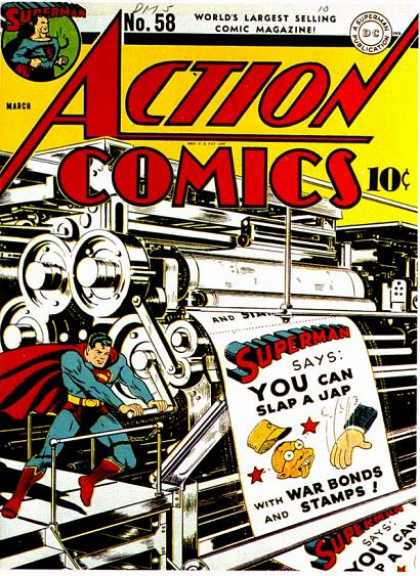
Okay so another post on a comic cover but what a cover to do a post on. This cover to Action Comics #58 is by today's standards unbridled racism. The date this issue was published was March of 1943.

First let’s talk about the cover, I love the use of color in this cover, the printer in black and white gives a stark contrast to Superman and the posters he is churning out and of course the topic of this post is about the posters.
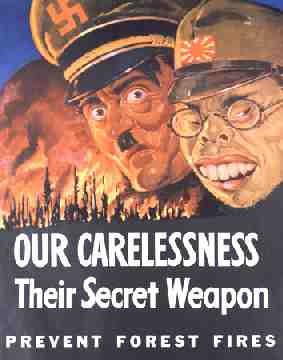
As you all know the United States was in the middle of World War II by 1943, over a year had gone by since the Japanese had bombed Pearl Harbor. The depiction of the Japanese solider is pretty much standard fare at this time, I mean check out some of the posters the United States government put out during the war.
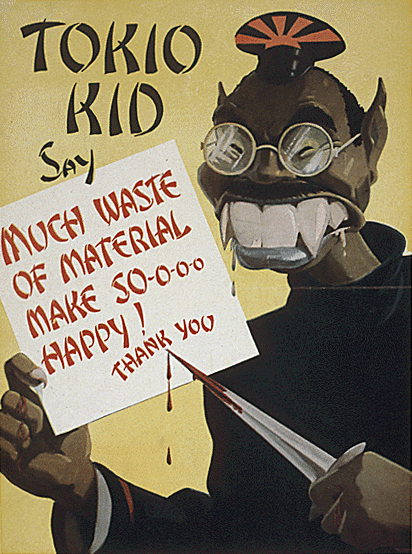
There is a term used by historians call the zeitgeist, The concept of Zeitgeist goes back to Johann Gottfried Herder and other German Romantics such as Cornelius Jagdmann, but is best known in relation to Hegel's philosophy of history. In 1769 Herder wrote a critique of the work Genius seculi by the philologist Christian Adolph Klotz and introduced the word Zeitgeist into German as a translation of genius seculi (Latin: genius - "guardian spirit" and saeculi - "of the century").

The word is defined as the spirit of the time; the taste and outlook characteristic of a period or generation.


Putting zeigeist to work means that you and I living in the 21st century should not make value judgments on people in the past. An example of this is you and I saying that the cover to Action Comics #58 is racist, but if we remember the zeitgeist or spirit of that time it was not seen as racist, it was seen as patriotic, a perfectly acceptable advertisement to raise awareness for war bonds to help fight against the enemy.

There are lots of examples of when we should use the theory of zeigeist. Slavery is one where you could apply it to, say, when thinking about our founding fathers being slave owners. Is slavery wrong? Absolutely it is but to say our founding fathers were horrible men for being slave owners then that flys in the face of the thoughts, beliefs and spirit of that time.

So that is one topic for this post, on to the next one, war bonds, this will be quick.

According to this site: http://www.u-s-history.com/pages/h1682.html

“The last time the United States issued war bonds was during World War II, when full employment collided with rationing, and war bonds were seen as a way to remove money from circulation as well as reduce inflation.

Issued by the U.S. Government, they were first called Defense Bonds. The name was changed to War Bonds after the Japanese attack on Pearl Harbor, December 7, 1941.

An emotional appeal went out to citizens by means of advertising. Even though the bonds offered a rate of return below the market value, it represented a moral and financial stake in the war effort. The advertisements started with radio and newspapers, then later added magazines to reach the masses. The bond campaign was unique in that both the government, as well as private companies, created the advertisements

At the end of World War II, January 3, 1946, the last proceeds from the Victory War Bond campaign were deposited into the U.S. Treasury. More than 85 million Americans — half the population — purchased bonds totaling $185.7 billion. Those incredible results, due to the mass selling efforts of helping to finance the war, have never since been matched.”

So there you go – Superman did his part in selling War Bonds.

Onto the Japanese and what they went through during World War II,

Per this site: http://www.infoplease.com/spot/internment1.html
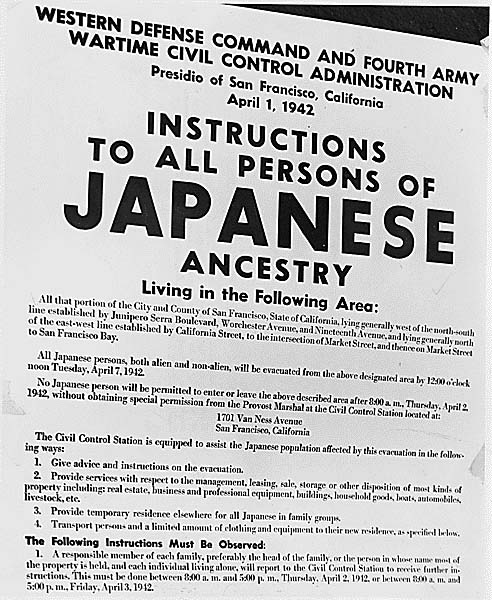
“On February 19, 1942, soon after the beginning of World War II, Franklin D. Roosevelt signed Executive Order 9066. The evacuation order commenced the round-up of 120,000 Americans of Japanese heritage to one of 10 internment camps—officially called "relocation centers"—in California, Idaho, Utah, Arizona, Wyoming, Colorado, and Arkansas.”

Roosevelt's executive order was fueled by anti-Japanese sentiment among farmers who competed against Japanese labor, politicians who sided with anti-Japanese constituencies, and the general public, whose frenzy was heightened by the Japanese attack of Pearl Harbor. More than 2/3 of the Japanese who were interned in the spring of 1942 were citizens of the United States.

The U.S. internment camps were overcrowded and provided poor living conditions. According to a 1943 report published by the War Relocation Authority (the administering agency), Japanese Americans were housed in "tarpaper-covered barracks of simple frame construction without plumbing or cooking facilities of any kind." Coal was hard to come by, and internees slept under as many blankets as they were alloted. Food was rationed out at an expense of 48 cents per internee, and served by fellow internees in a mess hall of 250-300 people.

Eventually the government allowed internees to leave the concentration camps if they enlisted in the U.S. Army. This offer was not well received. Only 1,200 internees chose to do so

In 1944, two and a half years after signing Executive Order 9066, fourth-term President Franklin D. Roosevelt rescinded the order. The last internment camp was closed by the end of 1945.”
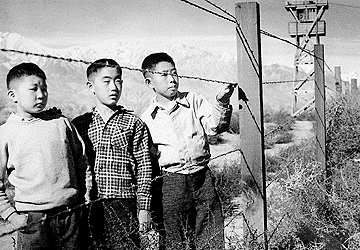
Now I could comment on the camps and the right and the wrong of it but that would violate the zeitgeist of the time.

January 14, 2008

Historical Covers - Action Comics #43

So in what I envision as being a recurring post on comic history (a.k.a. an easy out when I can't think of a topic to write about). I want to take a look at old covers and discuss some of the elements that appear in them.

First off lets discuss what I think constitutes a good cover for this blog, since I am the one to writing about them. We can begin our discussion with a great cover on an old Action Comics issue.

By the way I found this site today and will link it in my resource section but http://www.coverbrowser.com/ is absolutely sweet and makes my job so much easier.

Okay lets take this cover from Action Comics #17, it has Superman lifting a pretty unique looking tank. The tank is officially known as Mk. IV, no. 6039, and saw service in France during World War I and is unofficially known as the "female tank." Interesting? Sure but not enough to do a whole post on.


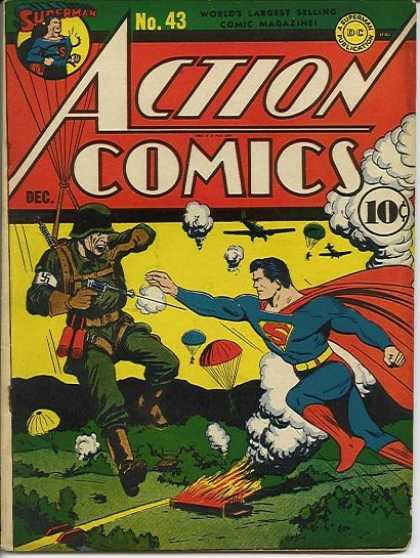
Now this cover to Action #43 has Superman flying up to meet a German paratrooper who is taking potshots with his pistol. Good luck with that Fritz! This cover has more than enough elements for a good post.


It starts with the German's attacking one lone building, seems like a bit of an overkill to drop a bunch of paratroopers down to take out a lone building but maybe it held some top secret French weapon that could have stopped the Nazi's from going around the Maginot Line. Perhaps the French were developing common sense in this building, I don't know but Hitler felt it important to send two planes and paratroopers in to take it out and it worked like a charm, except for this guy who is about to get a swift flying uppercut courtesy of the US of A and Superman. You want some apple pie with this knuckle sandwich ya ratzi?

So let's talk about the German Paratroopers shall we? "The Nazi paratroopers were known as Fallschirmjager which translated means Paratrooper Hunter. They were the elite airborne and ground units of the Luftwaffe. On 11th May 1936, Major Bruno Oswald Brauer made the first parachute jump from a wing of a Klemm KL25 sporting aircraft and became the first German Fallschirmjager to be given a Fallschirmschutzenschein (parachuting licence).

The German military was among the first to drop soldiers into battle far behind enemy lines. They would take this concept to new levels and use these airborne soldiers in the first operations of WWII.

The Fallschirmjager Ten Commandments

1. You are the chosen ones of the German Army. You will seek combat and train yourselves to endure any manner of test. To you, the battle shall be fulfillment.

2. Cultivate true comradeship, for by the aid of your comrades you will conquer or die.

3. Beware of talking. Be not corruptible. Men act while women chatter. Chatter may bring you to the grave.

4. Be calm and prudent, strong and resolute. Valour and enthusiasm of an offensive spirit will cause you to prevail in the attack.

5. The most precious thing in the presence of the foe is ammunition. He who shoots uselessly, merely to comfort himself, is a man of straw who merits not the title of Parachutist.

6. Never surrender, to you death or victory must be a point of honour.

7. You can triumph only if your weapons are good. See to it that you submit yourself to this law - first my weapon and then myself.

8. You must grasp the full purpose of every enterprise, so that if your leader is killed you can fulfil it.

9. Against an open foe, fight with chivalry, but to a guerrilla, extend no quarter.

10. Keep your eyes wide open. Tune yourself to the top most pitch. Be nimble as a greyhound, as tough as leather, as hard as Krupp steel and so you shall be the German warrior incarnate.

Their most famous airdrop was in the Battle of Crete in 1941, where the entire 7th Air Division division was deployed along with other assets such as the German 22nd Air Landing Division. The operation was successful in capturing Crete, but the high casualties among the Fallschirmjager convinced Hitler that such mass airdrops were no longer feasible - though it has to be noted that surprise was lost even before the drops started, and the battle might have caused less German causalities otherwise. Still, the Allies would come to a similar conclusion near the end of the war, as each successive large-scale airdrop resulted in higher and higher casualties.

After Crete, the Fallschirmjagers would never again be used in large scale airborne operations. However, these highly trained, elite soldiers would conduct smaller scale operations throughout the war, culminating in the pinnacle battle that won them there place in the annals of military history."

All of this information and some sweet pictures and paintings can be found at:http://www.sixthscalebattle.com/photo2.html

So there you have it, I would say that the cover to Action #43 makes for a pretty good cover to write a post on. Your thoughts?

January 10, 2008

Superman and World History.

I figure it is only right to have my first blog entry on the first superhero, Superman. Not only is this more than enough of a good reason to start with Superman but he is also the reason for this blog. I became interested in the whole idea of teaching history through the use of comics due to Superman’s early adventures. I bought a copy of The Greatest Superman Stories Ever Told and in that collection there was a story about Superman arresting Hitler and Stalin. It does not get any better than that for a young superhero and history buff.

I eventually wrote a speech about Superman and how his power levels rose with the increase in power of the United States. Then a buddy and I started up the Four Color Podcast, which is in hiatus due to my busy schedule, and now here I am going solo.

Now let me be honest, I am a bigger fan of the modern Batman than I am of the modern Superman but in reading DC’s sweet Chronicles collections I am finding more and more that I totally dig the golden age Superman far more than the GA Batman.

After three volumes of each I think I have it pinned down as to why. GA Supes was quite the world traveler, he was kicking ass worldwide while Batman kept is ass kicking strictly in Gotham.
So for my purposes Superman provides a lot more examples of world history than Batman. GA Superman went looking for trouble of all sorts, and early on much like Batman he was taking on street level crime and government officials but more importantly Superman was traveling overseas.

One of the best examples of Superman intermixing with world events is in Action Comics #22. In this exciting issue Clark and Lois head overseas to report on the war in Europe, it was of course between totally made up countries but Superman intervenes to sort the whole mess out.


Now in order to get overseas in the early twentieth century you had to take an ocean liner, which goes without saying, is very cool. The first passenger flight across the Atlantic was on June 28, 1939. Action Comics #22 was published in March 1940 so this mode of travel was very new and very expensive much more than even a great metropolitan newspaper is going to pay for two reporters. Now having your main characters cross the ocean in a boat is neat and all but very boring so nine times our of ten, Clark got into trouble and ended up swimming the rest of the way as Superman.


GA Superman could not fly like he can now; remember he was only “faster than a speeding bullet, more powerful than a locomotive and able to leap tall buildings in a single bound.”
Another great travel tip of GA Superman’s was to jump on top of a plane and hitch a ride.

Now my first example of Superman intersecting with history is an adventure where the Ultra Humanite who had his brain placed into the smoking hot body of Dolores Winters’, which leads to comicdom’s first transvestite. No Ultra Dolores had been macking on a scientist in order to get his place for his nuclear disintegrator. That’s right nuclear. “It’s pronounced nu-cle-er”.

This was published in 1940 and the first nuclear bomb was in New Mexico on July 16, 1945. Not only that but over at Comic Book Urban Legends Revealed, Brian Cronin wrote that “Alvin Schwartz wrote Superman stories in the 1940s and 1950s, including the daily comic strips at one point.
In one story, Superman fought Professor Duske, who had a cyclotron (one of the earliest types of particle accelerators).

According to the Amazing World of DC Comics #16, the United States War Department was alarmed by this story, and in a letter from the War Department to the District Engineer at the United States Engineer Office in Tennessee, expressed their concern.

They were not, as some people feared, upset about the level of detail the books went into, but rather, the fact that having a cyclotron appear in a comic book would cause the public to take the device less seriously, and the government wanted its citizens to have a healthy amount of fear about the nuclear devices the government used.”

http://goodcomics.comicbookresources.com/2005/07/14/comic-book-urban-legends-revealed-7/

Plus one of the readers there posted this:

“Battle of the Atoms” was originally going to appear in late 1944, but finally appeared in Superman #38 (January-February 1946) and featured a classic battle with Luthor save for the fact that Luthor’s new weapon was an “Atomic Bomb”. Since the Manhattan project, which gave rise to the first two American nuclear weapons, was in full swing in 1944, the Defense Department wanted nothing tipping off the Germans that America was even considering work on an atomic bomb, not even from a comic book. While the weapon used by Luthor looked nothing like the actual weapon, and was not anywhere near as destructive as the real bomb, government agents came to DC’s offices and demanded that the story not be printed until official clearance was given, citing the need for a unified national defense. Obviously, the people at DC were confused, realizing that they must have come up with something more than their normal fantastic story.

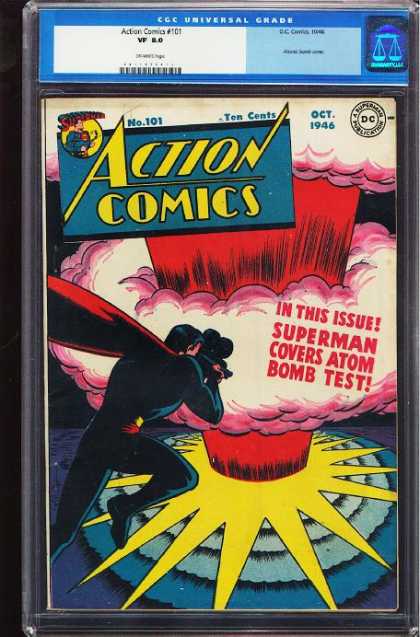
Following that, another story, “Crime Paradise”, was also censored and delayed. It ultimately appeared in 1946 in Action Comics #101 and told the story of Superman covering an atom bomb test, actually filming it for the Army. It featured a great cover by Wayne Boring and Stan Kaye showing an explosion with the now familiar “mushroom cloud”.


“Battle of The Atoms” was reprinted in SUPERMAN, V1 #243.

http://www.supermanhomepage.com/comics/comics.php?topic=articles/supes-war

The second example I have is possible they greatest piece of wish fulfillment ever was published in comics. In this story Superman decided to end the war in Europe by heading over and capturing Hitler and Stalin, you know the guy who lead the country we teamed up with to kick Hitler’s ass.


He takes both of them to the soon to be defunct League of Nations to have them sentence them in a tribunal.

Some of the cooler aspects of this story to me is the art of the soldier’s outfits, the weapons used and the tanks and planes that GA Superman tears through.

Not only this but it is total political commentary but Shuster and Siegel. You would never see two real life political figures used in a comic book story where a hero goes out to take them down and not only that but has a friggin wartime tribunal waiting to try their asses for crimes against humanity.

Germany and the Soviet Union had a treaty for a while and it was called the Nazi-Soviet Non-Aggression Pact, which was signed in 1939 but ended in June of 1941 when Germany invaded the Soviet Union. The United States then extended its Lend-Lease act to the Soviet Union in September of 1941.

It is great to see what Shuster and Siegel nailed Stalin early on but the story was published in Look Magazine in 1943, which is right smack in the middle of our alliance with Stalin and the Soviet Union.

Okay back to my original point, you will never see two real life political figures featured in a comic book story nor would they be judged like Stalin and Hitler were.

Just another reason to love the Golden Age.